

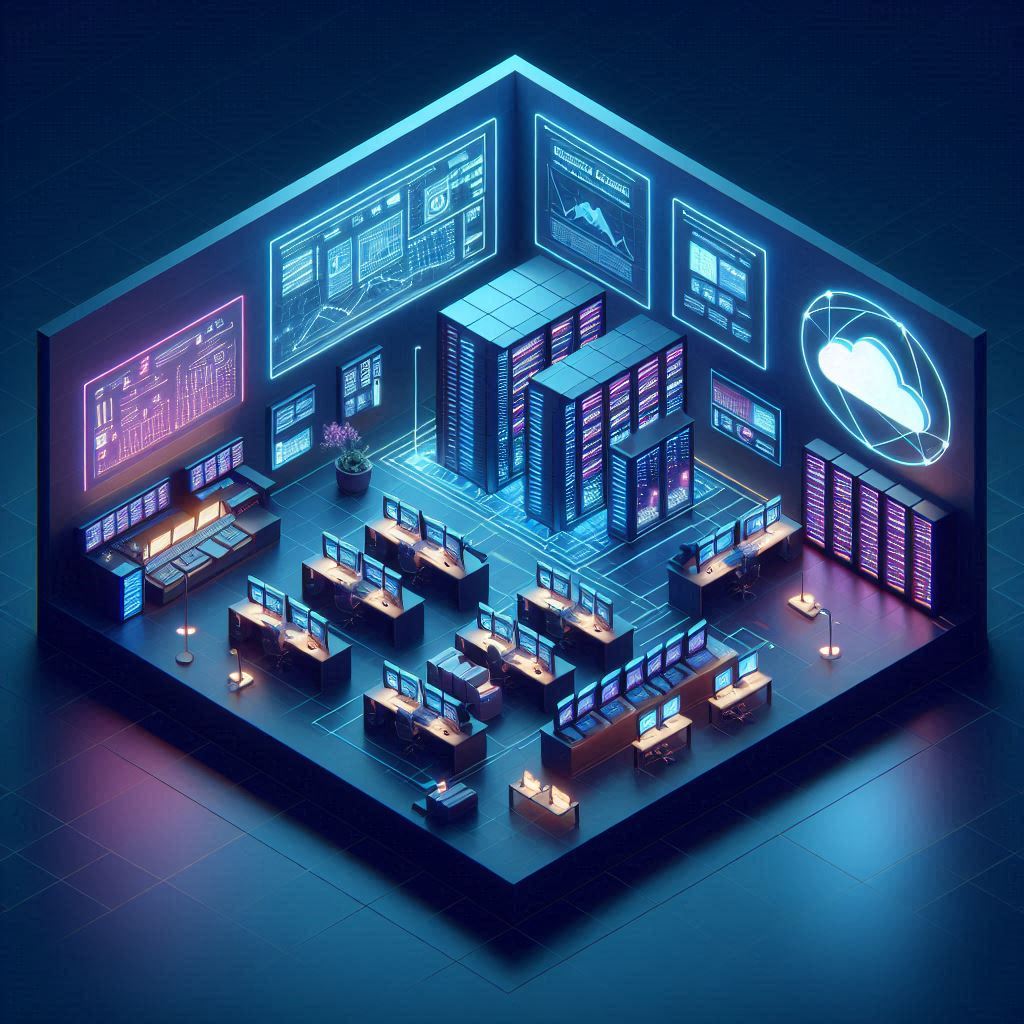

For modern companies, Information Technology infrastructure transcends the traditional conception of operational support and takes on a fundamental role as the foundation of the business. A great product and an efficient sales team are no match for a user experience marked by slowness, system crashes, and instability.
In this scenario, a NOC (Network Operations Center) proves to be fundamental for the operational continuity of your company. High availability and compliance with SLAs can only be achieved with constant surveillance of your digital assets.
This comprehensive dossier explores the details of a NOC, the financial and operational dilemma between building an in-house structure versus adopting the NOC as a Service (outsourced) model, and how dbsnOOp’s cutting-edge technology is revolutionizing operational efficiency through AI, automation, and the Virtual NOC.
1. What, in fact, is a NOC?
Primarily, a NOC functions as a centralized and unified intelligence platform. In it, the company and its technical team exercise uninterrupted, 24/7 supervision over the entire critical infrastructure. This can encompass a complex ecosystem: applications, networks, firewalls, databases, internet links, IoT devices, and any external or cloud operational environments.
However, defining a NOC merely as “monitoring” underestimates its function. The overall goal is to ensure business continuity and compliance. For this, the defenses against cyber threats and performance risks can be highly varied.
Vital Functions of the NOC
To ensure a frictionless operation, the NOC performs a series of critical operational tasks that go far beyond watching colorful screens and graphs:
- Systemic Health Surveillance: Granular monitoring of servers, databases, and applications to ensure that CPU, memory, and disk are operating within ideal parameters.
- Continuous Security Analysis: Perpetual surveillance against vulnerabilities. The NOC not only observes traffic but also identifies anomalous patterns that may indicate an intrusion attempt or an imminent security failure.
- Bandwidth Management: Evaluation of network usage to identify excessive consumption bottlenecks that could degrade the end-user experience.
- Firewall Governance: Active assistance in managing rules and blocks, ensuring that the network perimeter remains secure without impeding the legitimate flow of business.
- Root Cause Detection: Studies indicate that the use of a structured NOC can accelerate the detection of problems and their respective root causes by up to 50% to 200%, in addition to doubling the diagnostic accuracy. This means solving the real problem, not just treating the symptom.
Unlike a traditional Help Desk, which is reactive and depends on a frustrated user opening a ticket to report an error, the NOC is proactive: it uses advanced tools to mitigate failures even before the user realizes that something was about to go wrong.
2. Build or Outsource?
One of the critical decisions a CIO or IT manager must make is the choice between maintaining an in-house NOC or adopting the NOC as a Service model. Both approaches have their merits, but the analysis must go beyond personal preference and focus on financial and operational viability.
In-House NOC: Total Control?
Many companies initially opt for an in-house NOC under the premise of maintaining absolute control over their data and processes.
The Advantages of the In-House Model:
- Control and Customization: The company defines every rule, policy, and monitoring process, adjusting the operation minutely to the organizational culture.
- Data Sovereignty: For extremely regulated sectors, keeping all operations in-house can offer an additional layer of perceived control and security against data leakage.
- Immediate Response (Theoretical): The team is part of the corporate structure itself, whether physically present or remote, which, in theory, eliminates communication barriers.
Operational and Financial Reality:
Despite everything, the reality of maintaining an in-house NOC is brutally challenging, especially in the Brazilian economic scenario.
Prohibitive Costs of Maintaining an In-House Structure:
- Maintaining an in-house structure dedicated to the operation and monitoring of IT environments represents a high and continuous investment.
- In Brazil, it is estimated that the monthly cost to sustain a functional operation with an operational margin is around R$ 20,000.00.
- This translates to an approximate annual cost of R$ 240,000.00.
- This amount is not limited to just salaries and labor charges. It also includes:
- Acquisition and maintenance of hardware
- Licenses for monitoring software
- Physical infrastructure of the operations room, such as panels, displays, and cooling systems
- Electricity consumption
- Various operational costs and amenities necessary for the continuous functioning of the team.
The 24/7 Nightmare:
There is also a major logistical challenge behind the NOC: the facility must operate uninterruptedly. Who will work the night shift? Who will cover weekends and holidays? The cost of overtime and night differentials scales quickly.
The “One-Person Department”:
Many companies try to save money by creating a department of one or two individuals. This generates catastrophic risks: absenteeism, vacations, illnesses, or simply professional burnout leave the company unassisted. A critical database cannot depend on the health of a single employee.
Talent Management:
Finding, training, and retaining qualified professionals to work in thankless shifts is difficult and time-consuming. Turnover in this sector is high, generating constant onboarding costs.
Outsourced NOC (NOC as a Service)
Outsourcing emerges as the rational answer for most companies seeking efficiency without the burden of CapEx (Capital Expenditure).
The Advantages of the Outsourced Model:
- Brutal Financial Efficiency: While maintaining an in-house operation costs around R$ 20,000.00 per month, hiring an outsourced NOC to monitor up to 20 technology assets presents a much lower investment.
- The monthly values of this service range between R
2,500.00andR2,500.00andR5,800.00. - In annual terms, this represents a cost between R
30,000.00andR30,000.00andR69,600.00. - Compared to the in-house model, the annual saving can reach approximately R$ 210,000.00.
- The monthly values of this service range between R
- Guaranteed Availability: NOC as a Service providers guarantee 24/7 coverage by contract (SLA). Problems of absenteeism, vacations, or holidays cease to be your company’s concern and become the supplier’s responsibility.
- Access to Experts: By hiring a service, you are not just hiring a monitor, but access to an experienced multidisciplinary team in various technologies, something that would be unfeasible in-house.
- Elastic Scalability: If your company grows and the number of assets doubles, the outsourced NOC scales instantly without the need for large investments in new hardware or time-consuming hires.
The Counterpoints:
Indeed, outsourcing requires careful vendor management. Furthermore, there will be a perception of less control over specific processes and a dependence on the quality of the partner. Finally, information security requires strict confidentiality agreements (NDAs) to mitigate risks of data leakage.
Financial Verdict:
The numbers can’t lie! If cost is a decisive factor, the outsourced NOC wins by a large margin, freeing up capital to invest in the company’s core business. The in-house model becomes viable only for organizations in which the cost of R$ 240,000.00 annually is irrelevant compared to the need for absolute control and sovereignty over ultra-sensitive data.
3. The (Not Always Obvious) Challenges of Operating a NOC
For those still considering internalization, or even for managers who need to audit their outsourced providers, it is vital to understand the complexity of the daily challenges of a Network Operations Center:
- Time Difficulties: Does the facility truly operate 24 hours a day? Is the night coverage real, or is it just an “on-call” system where the technician wakes up groggy to answer a call?
- The Logistics of Scale: Who will be physically or logically available on national holidays and weekends? Is the leave schedule mathematically correct to avoid labor liabilities?
- Hidden Human Cost: How much does it cost to keep employees satisfied working while the rest of the world sleeps? Night and hazard pay (depending on the location) add up quickly.
- Physical Infrastructure: Are there adequate facilities? Restrooms, kitchenette, rest areas? A tired or uncomfortable operator makes mistakes.
- Physical and Logical Security: Is the facility secure? Is the data accessed by the operators protected against social engineering or internal exfiltration?
- Legal Compliance: Is the company in full compliance with labor laws and industry regulations (like the LGPD)?
- Invisible Costs: Coffee, electricity, cleaning, property security, equipment depreciation. These items rarely make it into the initial spreadsheet but erode the budget.
- Software Licensing: The investment in enterprise monitoring tools (Zabbix, Prometheus, Datadog, dbsnOOp itself, which is more accessible) and visualization displays (Video Walls) represents a significant capital cost.
- The “One-Man Army” Risk: If you have a small department, how do you measure efficiency? The risk of creating a “black box” where only one employee knows how everything works is very high. If they leave, the knowledge goes with them.
- Monitoring the Monitor: Who watches the watcher? How do you ensure that the night shift team is not taking “endless naps”?
If the uninterrupted continuity of your data operations is critical to your business, it must be monitored and supported 24/7. The complexity of these 10 challenges reinforces the thesis that, for the vast majority of companies, delegating this responsibility to specialists is the wisest decision.
4. ROI and Efficiency
The implementation of a NOC, whether in-house or outsourced, should be evaluated based on the Return on Investment (ROI). Market studies indicate that companies with outsourced NOCs show cost savings and a return of 28% when compared with companies that employ in-house maintenance.
But where does this saving come from?
Downtime Prevention:
The cost of downtime is the most terrifying metric for any company. Loss of sales, damage to reputation, and unproductivity of internal employees. NOCs implement preventive measures, such as regular backups and security patches, avoiding incidents that could cost millions.
Better Use of the In-house IT Team:
In companies with internal IT departments, the NOC acts as a strategic partner. Everything involving basic support, routine monitoring, and toil is absorbed by the NOC team, which frees up the team to focus on more strategic initiatives, innovation, and business development.
Comprehensive Service Suite:
Unlike a SOC (Security Operations Center) focused only on security, or a Help Desk focused on the user, the NOC offers an integrated suite. It takes care of the health of the hardware, the performance of the software, and the security of the network simultaneously. It is a holistic approach to technological health.
5. Virtual NOC
The natural evolution of the physical NOC, with its rooms full of screens and high costs, is the Virtual NOC and SaaS (Software as a Service) platforms. In this scenario, solutions like the dbsnOOp Virtual NOC emerge as the new standard of efficiency.
The dbsnOOp Virtual NOC acts as an orchestrator of your IT infrastructure and your team. It acts directly on the most important metrics of IT operation:
- MTTR (Mean Time to Resolve): How quickly does the system return to normal?
- MTTA (Mean Time to Acknowledge): How quickly do we know there is a problem?
Technological Differentiators of dbsnOOp
1. Real-Time Visibility and Proactive Monitoring:
At the core of the platform is a state-of-the-art monitoring technology. It provides full visibility over the health of the infrastructure. Whether monitoring servers, databases, links, or devices, the approach is preventive. The system identifies performance degradation before it becomes a critical failure, allowing for surgical and silent interventions, without impact to the end-user.
2. Incident Dispatch with Artificial Intelligence:
The great differentiator of the Virtual NOC is the elimination of the “human bottleneck” in triage. Traditional solutions depend on an operator reading an alert and deciding who to call. dbsnOOp uses intelligent algorithms and machine learning to automate this process.
The platform analyzes the severity of the incident, the impact on the business, and the availability of technical resources. Based on this, the incident is instantly routed to the most qualified professional or outsourced partner for resolution.
3. Collaboration and Transparency:
The system facilitates resolution workflows. Through integrated communication channels and customizable notifications, all stakeholders are notified. This promotes a culture of transparency. There are no more “black boxes” where IT says “we’re on it” and the business is left in the dark. Collaboration happens in real time.
4. Security and Compliance:
In a world guided by the LGPD and strict security standards, dbsnOOp prioritizes data protection. With robust encryption protocols, granular access controls, and integrated audit trails, the platform allows organizations to maintain compliance with regulatory requirements, increasing credibility in the market.
The Need for Evolution
The decision to implement a NOC is the first step towards a company’s technological maturity. The decision on how to implement it defines the financial efficiency of the business.
While the in-house NOC offers a sense of control at an exorbitant cost and with herculean logistical challenges, the outsourced NOC—powered by modern platforms like the dbsnOOp Virtual NOC—offers the agility, savings, and intelligence needed to compete in today’s market.
With affordable costs and technology that allows you to take care of your database and infrastructure 24/7, remotely and securely, solutions like those offered by dbsnOOp democratize access to high availability. Today, companies of different sizes can already have an elite ‘Control Tower’.
Schedule a demo here.
Learn more about dbsnOOp!
Learn about database monitoring with advanced tools here.
Visit our YouTube channel to learn about the platform and watch tutorials.
- Performance Tuning: how to increase speed without spending more on hardware: Before provisioning more expensive cloud instances, it’s crucial to exhaust software-level optimizations. This article covers performance tuning techniques that allow you to extract the maximum performance from your current environment, focusing on query and index optimization to solve the root cause of slowness, rather than just remedying the symptoms with more hardware resources.
- The Health Check that reveals hidden bottlenecks in your environment in 1 day: Understand the value of a quick and deep diagnosis in your data environment. This post details how a concentrated analysis, or Health Check, can identify chronic performance problems, suboptimal configurations, and security risks that go unnoticed by daily monitoring, providing a clear action plan for optimization.
- What is query degradation and why does it happen?: Performance tuning begins with identifying what is wrong. This article provides the theoretical basis, explaining in technical detail why queries, the main target of tuning, degrade over time. It is essential reading to understand the nature of the problem that dbsnOOp solves.